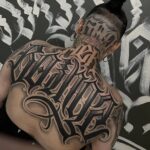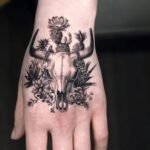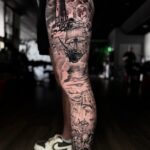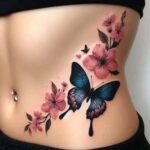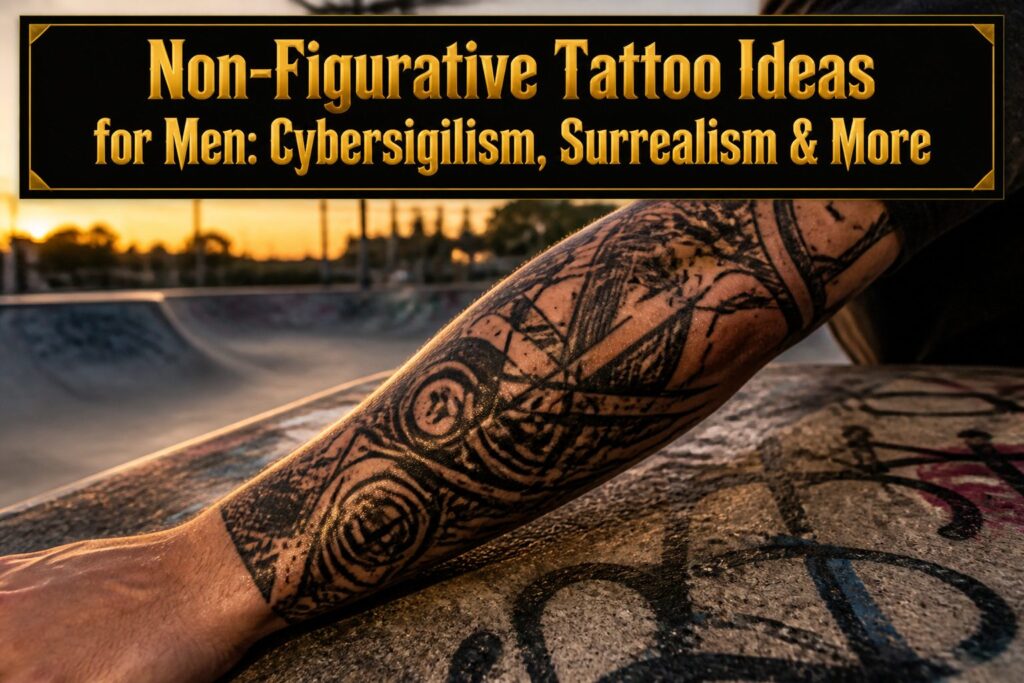
A non-figurative tattoo for men is ink that abandons recognizable imagery in favor of pure shape, line, and texture.
Without a figure to anchor it, the design lives or dies by the artist’s precision; blur a line in abstract work and you have grey noise, not a stylized bow.
The style called cybersigilism, born in Berlin’s late-2010s club scene and now on rap merch and runways, fuses HR Giger’s biomechanical horror with Norse knotwork and Polynesian geometry filtered through a digital-native sensibility.
Cybersigilism
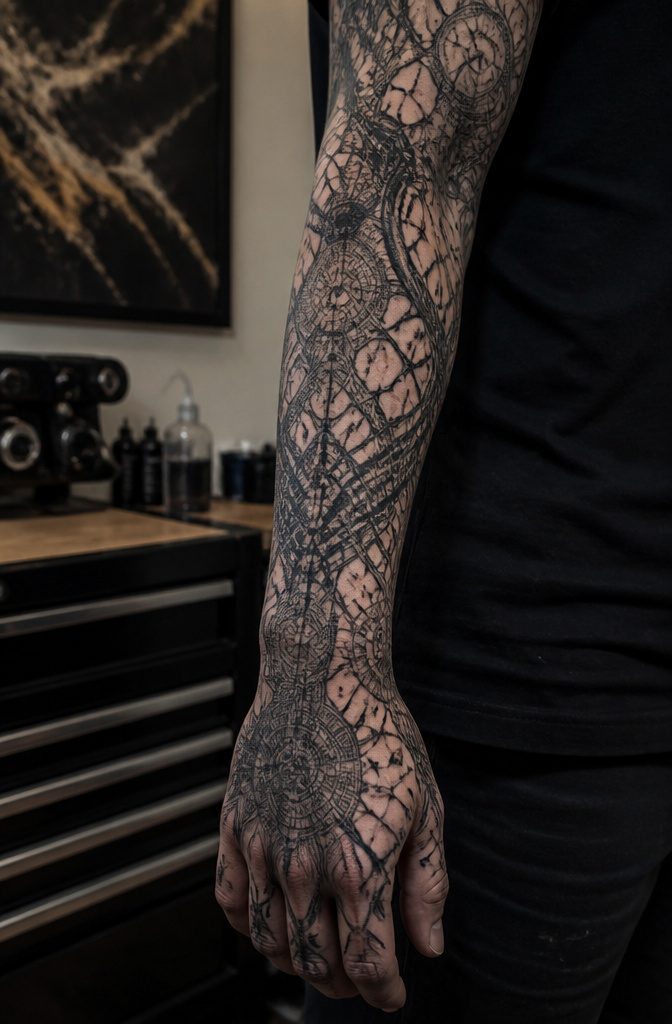
Blackwork that looks like alien vascular networks started spreading through Berlin’s club scene in the late 2010s, and by the early 2020s it had jumped to runways, rap merch, and mainstream pop stars.
The style fuses HR Giger’s biomechanical horror with metal-band logo aesthetics and Art Nouveau electrical currents, creating something that reads as both organic and mechanical. Some call it cybersigilism; others just call it Gen Z tribal.
The fine-line, spiderweb patterns draw on Norse and Celtic symbols, Borneo and Polynesian shapes, and mandala geometry, but filter them through a digital-native sensibility.
An LA artist who uses @cybersigilism as a handle noted that people describe the work as looking like a witch’s curse, a metaphor that captures the deliberately unsettled, maximalist energy of the style.
It arrived as a reaction against millennial minimalism, embracing instead the chaotic, "trashy" Y2K aesthetic that dominates certain corners of online culture.
A tattoo historian frames the appeal as a response to living in cyber reality while facing economic hardship, war, and climate anxiety.
The more digitally connected people become, the more untethered they feel, and ancient symbols scratched into skin offer a sense of rootedness. Whether that connection justifies the borrowing is a genuine tension in the style.
The same researcher argues that Western tattooing is broadly cultural appropriation, and that fresh labels and thinner lines do not erase the Indigenous origins of putting ink into skin as a practice.

Clean, Flawless Transfers: Your artwork will look so clean once transferred to the skin with the Stencil Stuff gel! Gentle on the skin, Stencil Stuff transfer solution helps you achieve clear and sharp tattoo stencil transfers every time!

Safe and Healthy: Our tattoo transfer gel meets strict safety and non-toxic material standards, non-irritating to the skin and vegan-friendly. Maintains client comfort while achieving clear tattoo stencil transfers.

Warm Tips: The tattoo transfer paper need to work with transfer medias.You will need to purchase the stencil ointment separately. Apply the design made on the master paper. Please pay attention to press the back side of the pattern to the skin for at least 3 seconds
Abstract Tattooing
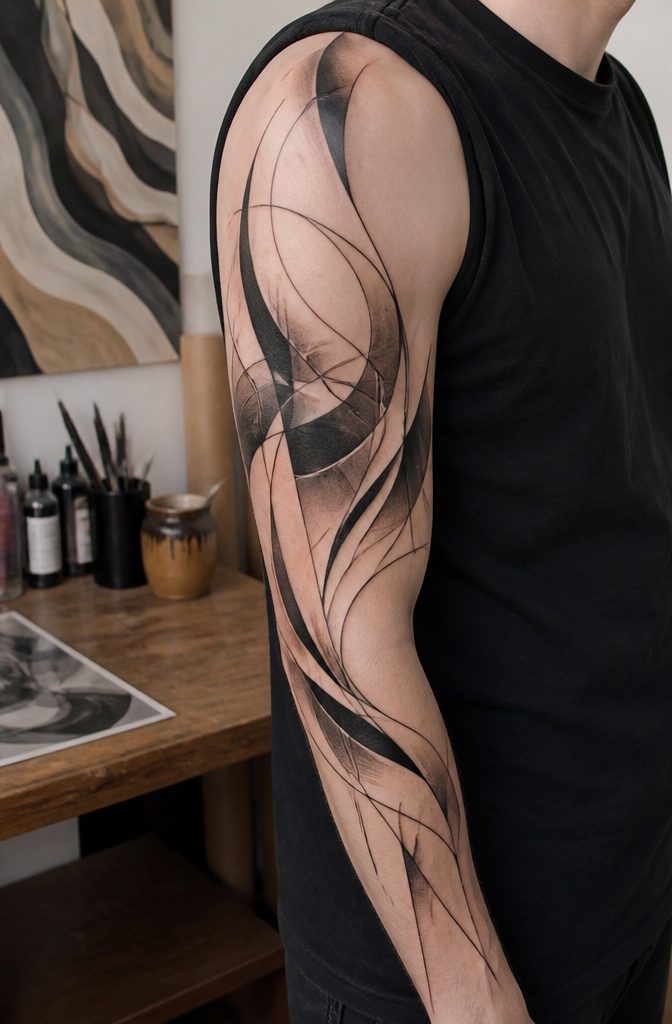
Abstract tattooing strips away the recognizable subject and lets shape, line, and texture carry the whole piece.
A bow rendered in flowing, unnameable curves or an arm cuff built from repeated geometric marks does not depict anything you can point to, yet it still registers as deliberate and complete.
The body becomes the canvas for decoration rather than storytelling, with placement itself doing the visual work.
This approach overlaps with ornamental and dotwork practices, though it stays looser than both.
Where ornamental tattooing might lock into pattern repetition, abstract work can break rhythm mid-piece, letting negative space or a sudden shift in line weight redirect the eye.
Dotwork, by contrast, builds tone through accumulated points that may or may not resolve into an image; abstract dotwork keeps those points unmoored from representation entirely.
The distinction matters when you are choosing an artist. Someone who advertises abstract work should show pieces without detectable subjects, not stylized versions of real things.
Ask to see healed photos too. Lines that read as spontaneous on day one can blur into indistinct grey if the artist worked too fast or too shallow, and abstraction offers no figurative anchor to hide behind.

👽 96 PCS MEGA VALUE PACK: Includes 8 sheets of delightful Alien & Space themed pre-cut temporary tattoos, featuring 96 unique and playful designs! Each sheet measures 6.3 inch x 4.7 inch, making them perfectly sized for both kids and adults to enjoy at any out-of-this-world event.

👽 Glowing Alien Tattoos – Fun alien glow tattoos with UFO, astronaut, and space designs that shine under light, perfect for boys and girls.

Variety Pack: This set includes 77 sheets of realistic alien-themed temporary tattoos featuring vibrant colors green alien spaceship space cat designs.
Surrealistic Blackwork
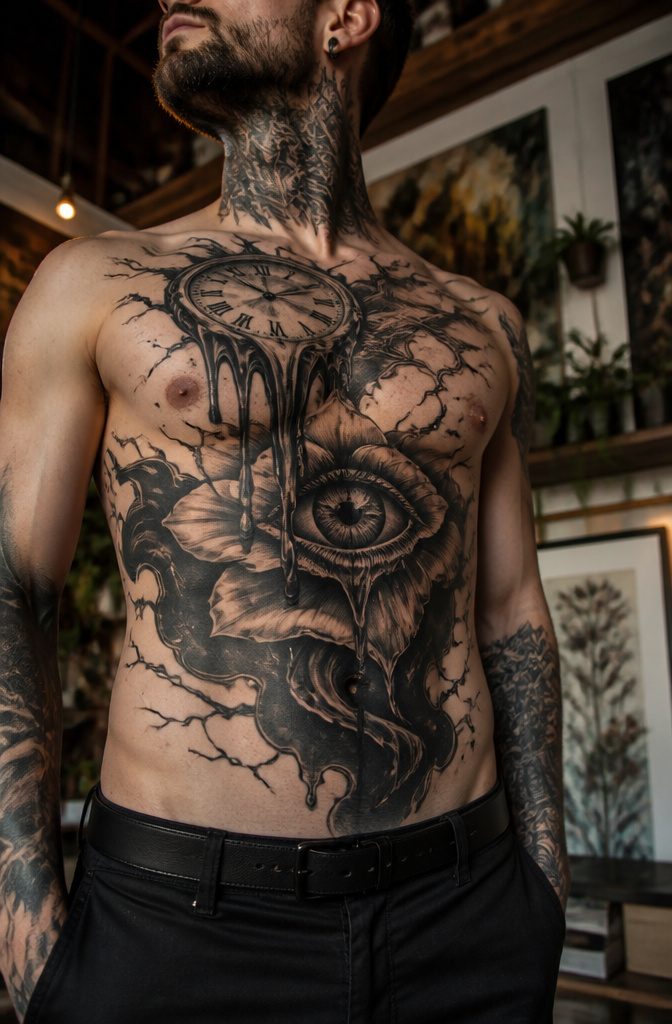
Surrealistic blackwork takes the high-contrast punch of traditional black ink and bends it into imagery that refuses to sit still.
A clock melts across a forearm. An eye opens inside a flower where the pupil should be.
The solid black fields anchor the design so it still reads from across a room, but the closer you get, the more the logic unravels, which is exactly the point.
The style works best when the artist commits fully to both sides of the equation: the blackwork must be dense enough to last, and the surreal element has to be strange enough that it doesn’t resolve into something familiar after six months.
I’ve seen pieces that looked haunting in the shop and turned into busy dark blobs once the skin settled. The ones that hold up keep the dreamlike imagery simple, one impossible gesture rather than three competing ones.
Intricate patterns, fine-line webs and stippled textures, fill the negative space without softening the edge.
The result sits somewhere between a woodcut and a fever dream, which makes it a strong choice for a man who wants non-figurative work that still carries emotional weight.
Placement matters more here than in most styles; the solid black needs muscle or flat planes to age evenly, so chest panels, outer thighs and upper arms tend to outperform hands or ribs.

BOLD BODY ART is at your fingertips with hawink Skin Markers. Create vibrant temporary tattoos to complement cosplay outfits, Halloween costumes. Includes easy-to-use stencils. TEMPORARY TATTOO KIT includes 10 skin-safe body art pens and 56 large temporary tattoo stencils. Create eye-catching body art with a rainbow of tattoo marker pens that are skin-friendly.

Perfect for All Skill Levels: Designed for both professionals and beginners, the practice skins help artists refine techniques, build muscle memory and gain confidence. Whether you’re an apprentice or a seasoned artist, you’ll appreciate a versatile tool that grows with your skills. Now available in two distinct skin variations to match your training preference. Choose the Normal variant for a firmer feel, or select the Extra Soft Variation if you prefer a softer, more elastic surface.

Premium Quality 1.5mm Silicone Material – Crafted from premium 1.5mm thick silicone, this tattoo skin offers a true-to-life feel with excellent durability and a smooth surface for effortless needle movement during practice.
Dotwork
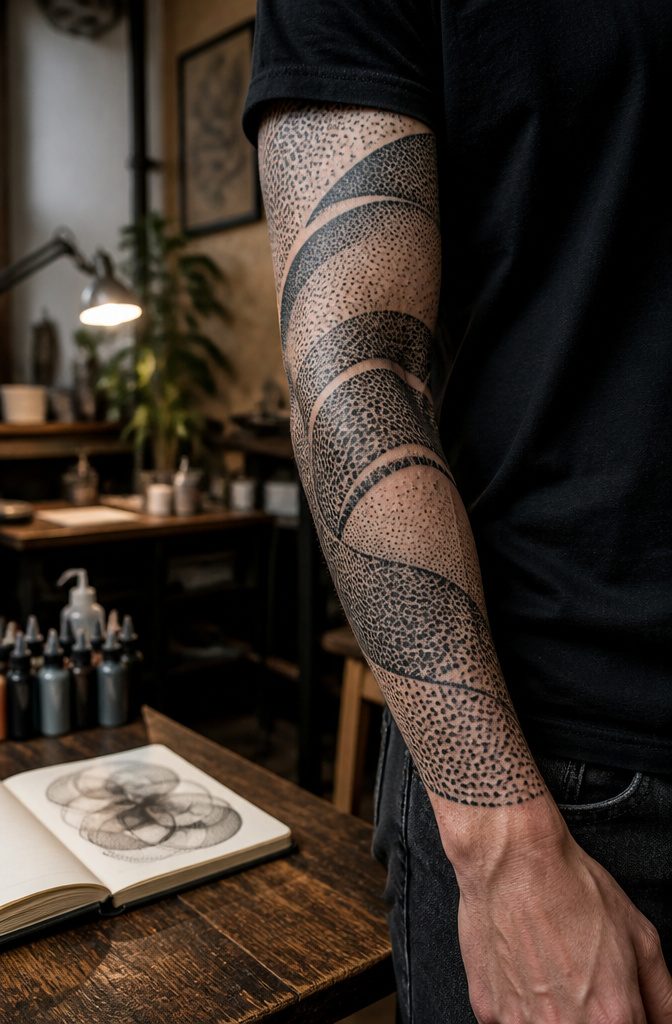
Dotwork builds an image from thousands of individual punctures, each dot placed by hand or machine to create tone, texture, or full form.
The density of the marks does the work that shading does in other styles: cluster the dots tight and you get shadow, spread them out and you get light.
A piece can read as a recognizable figure from across the room, then dissolve into pure pattern up close, which is why the style sits comfortably in non-figurative work even when it carries representational elements.
The technique opens up practical options other styles struggle with. A dotwork blastover, where new ink layers over old, stays light enough that it does not aggressively obscure the tattoo underneath or crowd the surrounding skin.
The same quality makes dotwork useful for large-scale ornamental pieces that need to hold visual weight without the heavy saturation of solid blackwork.
Some artists now fuse hand-poked dots with machine linework, combining the crispness of the machine with the softer, more organic register of hand-placed marks.
For a first piece or a sleeve continuation, dotwork offers a middle path between bold graphic readability and something more atmospheric.
Time is the real cost: building an image dot by dot takes longer than laying in solid fields or clean lines, and the price scales with those hours.
Healing tends to be straightforward, though the sheer number of punctures means the skin works harder in the first few days than it would with a simpler linework piece.

VIKING WARRIOR TEMPORARY TATTOOS: A bold mix of Celtic & Nordic inspired Vikin tattoos featuring runes, dragons, ravens, knotwork, and symbolic patterns - perfect for creating a powerful warrior look.

【Creative Pattern Design】CUTELIILI celtic viking tattoos using Norse and Viking style patterns are very individual, you can choose different patterns to meet different interests and needs.

Unique Design Viking Temporary Tattoo: Yazhiji Vikings were not only super cool, but also a symbol of strength, passion, and determination, reflecting strength, bravery and courage, the image of the Viking attracts the attention of history buffs and body art enthusiasts alike.
Ornamental Abstract
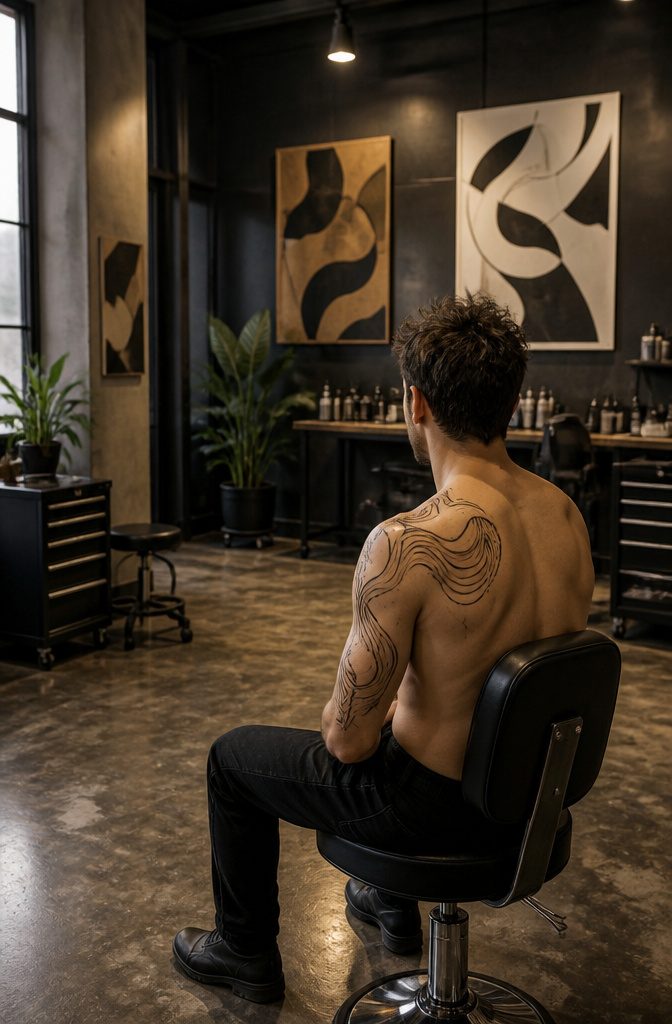
Ornamental abstract work treats the body itself as the canvas rather than the skin as a billboard for an image.
The tattoo wraps a shoulder, traces a collarbone, or runs down a spine in patterns that read as decoration first and subject second, if at all.
Lines repeat, shapes echo, and the negative space between marks matters as much as the ink.
Placement determines the whole design: a piece meant to cuff an upper arm gets drawn to that curve, and the same pattern flattened onto paper loses what makes it work.
This style borrows from jewelry, architecture, and textile patterns without representing any of them directly.
The appeal for a man building out a larger collection is coverage that flows between figurative pieces without competing for attention. It sits quietly, frames louder work, or stands alone as pure form.
Pain and healing run typical for linework, though large ornamental sessions can grind on joints and bone where the needle spends hours in one zone.
Cost scales with coverage and the precision required. An ornamental cuff by a specialist runs higher than a small single image, but the price buys continuity that scattered small tattoos rarely achieve.
The risk is decorative work that ages into visual noise. Thin lines blur, dense patterns can muddle, and a piece chosen only for its fit on Instagram may not read well at ten years.
I look for artists who show healed photos at two and five years out, not just fresh work, and I ask how the design will soften before I commit.

LARGE SCALE DESIGNS: This pack contains 8 sheets extra large tribal full arm temporary tattoos featuring intricate mandala, floral, and geometric patterns, 10 sheets half arm tattoos and 30 sheets small tattoo stickers.

Mandala, Mandala Lover, Mandala Tattoo, Geometric, Geometry, Sacred Geometry

Mandala, Mandala Lover, Mandala Tattoo, Geometric, Geometry, Sacred Geometry
Cultural Appropriation and Tattoo History
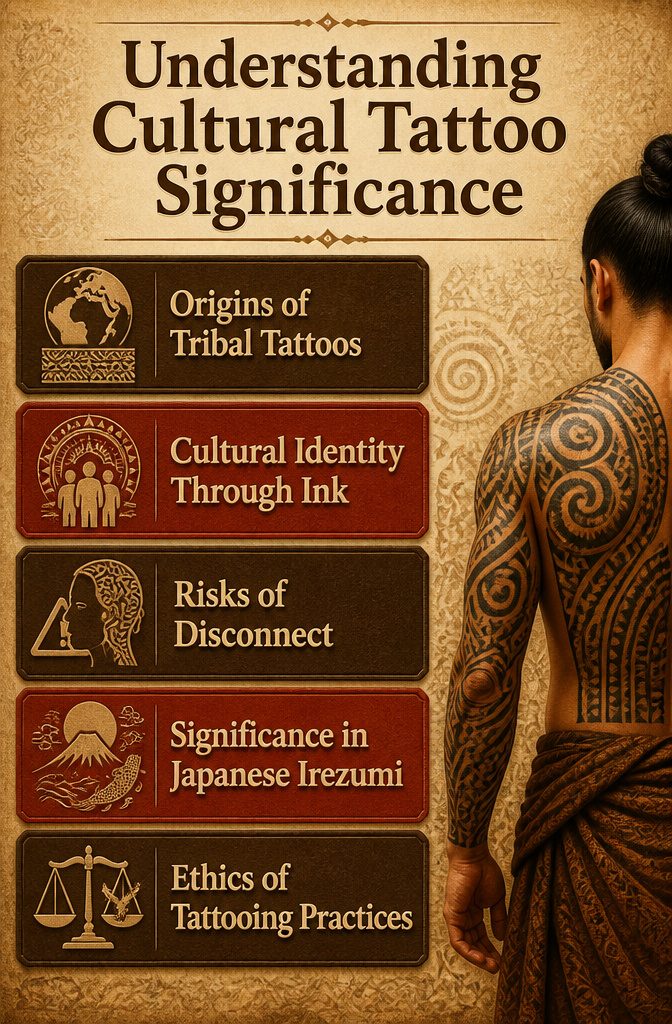
Tribal tattoos sit at the center of this conversation because the style carries weight that outlasts the needle. African, Polynesian, Arabic, and Indigenous American peoples used tattooing for cultural and tribal identification for hundreds, maybe thousands, of years.
Some communities still do. The geometric, pattern-oriented work that gets labeled "tribal" in Western shops flattens all of that into a visual shorthand, and the wearer often has no connection to the culture the design came from.
That disconnect is what turns borrowing into something more serious.
Japanese traditional tattooing, the irezumi style with its roots in nature motifs and myth, runs into the same wall. The historical significance stays with the culture, not the canvas.
I have watched friends spend months planning non-figurative pieces only to realize late that the swirling blackwork they wanted traced back to a specific people’s sacred patterns.
The better move for someone set on abstract or geometric work is to build from forms that do not carry someone else’s lineage.
Your back or forearm is real estate that lasts; the question is whether the design belongs to you in a way that holds up when the story behind it matters.

Premium Quality 1.5mm Silicone Material – Crafted from premium 1.5mm thick silicone, this tattoo skin offers a true-to-life feel with excellent durability and a smooth surface for effortless needle movement during practice.
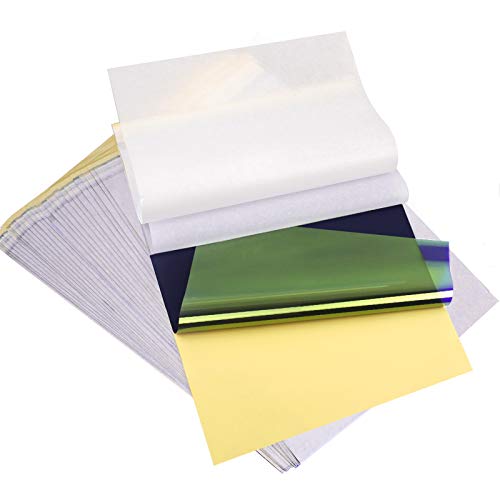
ADVANCED MATERIAL: Tattoo transfer paper is made with the high quality dyes and stencil paper. Transfer marks are very clear, clean and smooth. Tattoo transfer paper kit come with 35 sheets. Great for tattooing, trace and transfer images onto the body.<br>

Symbolism and the Eye Motif
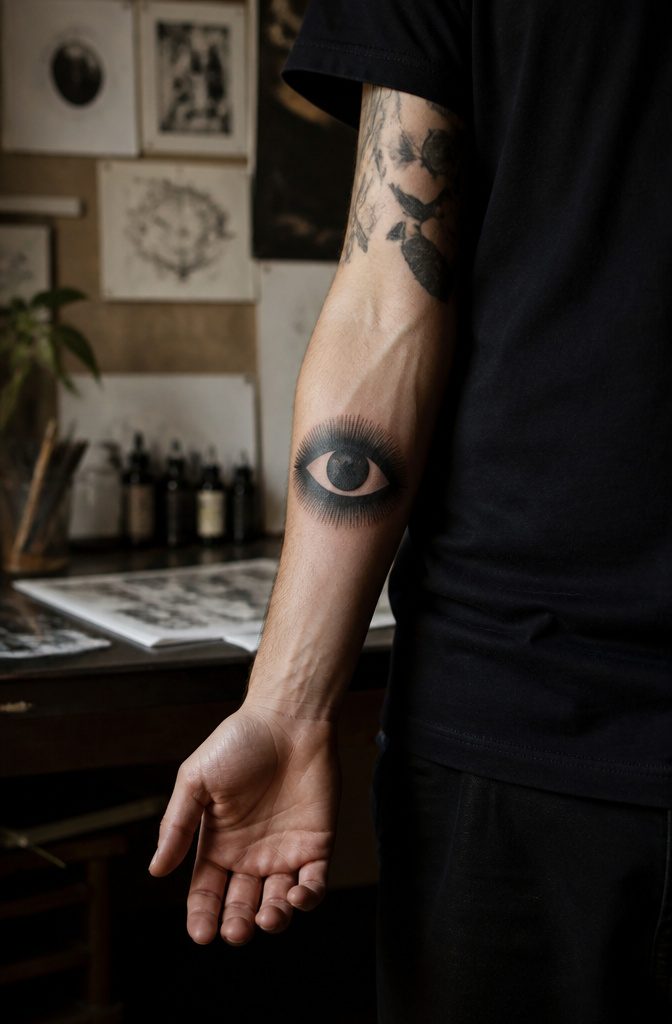
The eye motif lands differently in non-figurative work than it does in a literal portrait. Stripped of iris and lid, rendered in pure blackwork or graphic abstraction, the eye becomes perception itself rather than a picture of an eye.
A piece by Blckhrttt out of Leipzig does exactly this: solid black form, delicate grey shading at the edges, flame-like tendrils that suggest the eye is watching back even without anatomical detail.
That shift matters for a first tattoo or a tenth. The symbol carries what the wearer assigns it.
Divine watchfulness, protection, insight, a window to the soul. The graphic treatment lets you claim one meaning and let others read another.
In abstract and surrealistic blackwork especially, the eye floats without context, so the personal interpretation stays central. No story is imposed from outside.
Placement changes the weight. An eye on the inner forearm confronts the viewer; on a rib panel under shirt fabric, it stays private.
The cost scales with size and the artist’s demand, since blackwork this saturated takes steady hand time and multiple passes to hold.
My own bias leans toward keeping symbolic pieces where aging and sun won’t blur the edges the way loose traditional skins might, but that trade is between you and your calendar.

👽 Fun Alien Party Favors – Includes 60 colorful and unique alien tattoos in dimension 6.3x4.7 inch with spaceships, UFOs, planets, and galaxy creatures – perfect for space-themed parties or kids' celebrations.

Package contain : 256 packs of Green Alien themed Tattoos Temporary.

👽 Fun Alien Party Favors – Includes 96 colorful and unique alien tattoos in dimension 6.3x4.7 inch with spaceships, UFOs, planets, and galaxy creatures – perfect for space-themed parties or kids' celebrations, science teacher supplies, halloween
Tattooing as Identity
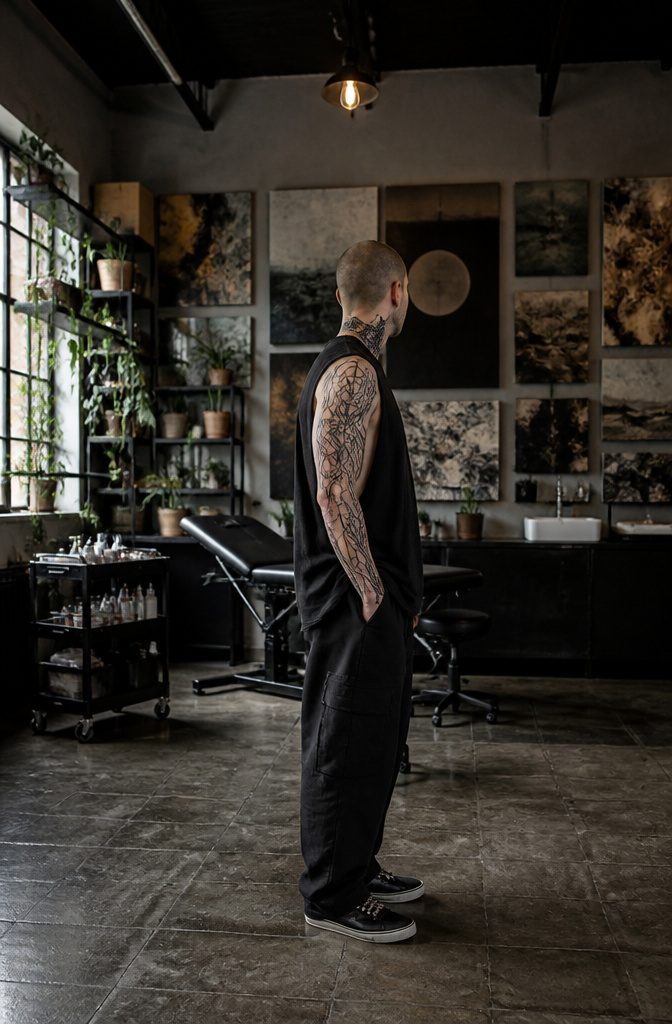
A non figurative tattoo man carries something the figurative piece can’t always give: room to belong without spelling it out.
The abstract mark, the sigil, the pattern that means nothing to a stranger, reads like a password to the people who share the scene. That is the draw, and the risk.
I have watched this play out in shops where the client walks in with a Pinterest board of dark, tangled linework and no word for it yet.
The artist names it cybersigilism, or something close, and the client nods because the name matters less than the recognition. The tattoo becomes a way to say "I am in this" without wearing a logo.
Subcultures have worked this way for decades. Punk had its fonts and placement rules.
Black metal had its specific corpse-paint geometries. The non-figurative piece continues that tradition in skin.
The limit is legibility across time. A dense blackwork sleeve that reads as "inside" now may read as noise in fifteen years when the subculture has shifted its vocabulary.
The ones that last tend to keep some formal clarity: a strong outline, a single anchoring shape, something the eye catches before the reference lands.
Without that, the identity mark becomes a period detail, and the wearer is left explaining a membership that expired.
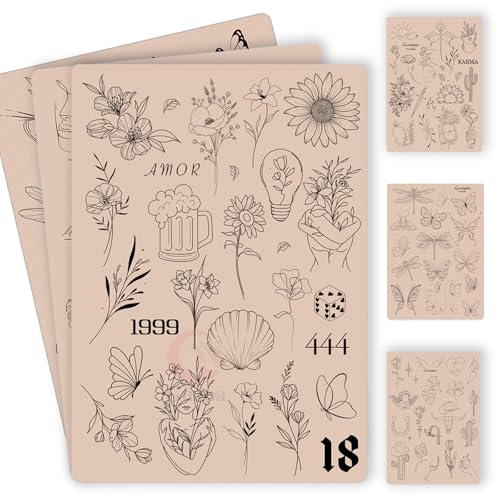
100+ Pre-Printed Designs – Features a wide variety of fine line and tiny tattoo stencils to enhance detailing skills.

Tiny Tattoo Practice Skin: the double-sided, easy-wipe, fine-line tattoo practice skins feature over 80 different stencil designs on the front and back of the skin.

Exclusive Mother and Baby Design: Inspires creativity while practicing intricate tattoo techniques.
Trends in Non-Figurative Work
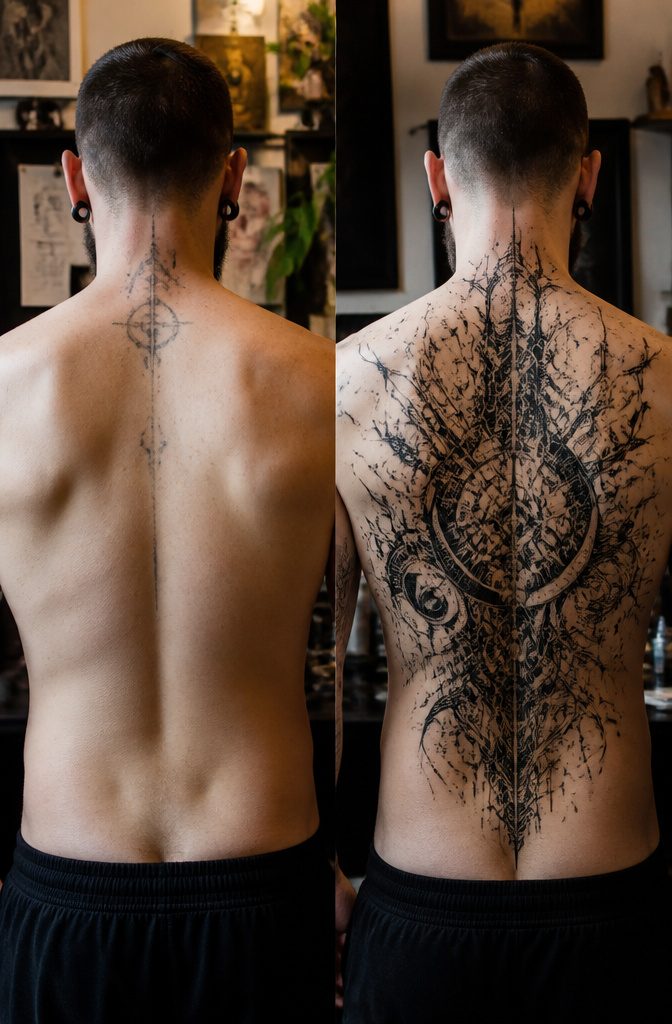
The late 2010s saw a clear swing away from the clean lines and negative space that dominated earlier Millennial taste.
Cybersigilism grew out of that rejection, starting in Berlin club scenes before spreading to LA studios and eventually mainstream artists like Playboi Carti and Billie Eilish.
The style’s spiderweb-like blackwork, with its mix of organic and mechanical forms, reads as maximalist where earlier trends had pushed toward restraint.
This rebellion against minimalism opened space for several non-figurative approaches to coexist. Abstract tattooing, which builds from shapes and textures rather than literal representation, now sits alongside surrealistic blackwork that blends dreamlike patterning with solid black ink.
The eye motif rendered by artists like Blckhrttt in Leipzig shows how these categories overlap: graphical and stylized, yet still carrying symbolic weight across cultures.
What started as generational pushback has settled into legitimate stylistic territory.
Where early cybersigilist work carried what some called a "cursed aura" and others dismissed as "Gen Z tribal," the broader field of non-figurative tattooing now offers men options that range from chaotic maximalism to controlled geometric abstraction.
The throughline is a willingness to let the form itself carry meaning, without requiring a recognizable image to anchor it.

Large Quantity Viking Tattoos : 77 sheets in total,17 sheets half arm sleeve viking tribal nordic fake tattoos in size 7.48"*3.74" and 60 sheets small viking tattoos in size 3.85"*2.28". Tribal Norse Viking temporary tattoos for adult men women kids

Features the ancient celtic symbol of the Trinity Knot, also known as the Triquetra, and notably found in the Book of Kells. It is now used to represent the father, son and holy spirit for Christians as well as the triple goddess for Wiccans and neopagans

Ancient Norse mythology design features a dragon tattoo with tribal knotwork. Perfect for fans of fantasy, Viking and mythical creature. This design shows the Celtic knot and Viking art.
Frequently Asked Questions
What is cybersigilism?
Cybersigilism is a tattoo style that fuses ancient-looking symbols with digital aesthetics, creating fine-line blackwork that looks like alien vascular networks or Art Nouveau electrical currents.
It draws on HR Giger’s biomechanical horror, metal-band logo design, and Norse, Celtic, Borneo, and Polynesian shapes, then filters them through a digital-native sensibility.
The style emerged in Berlin’s club scene in the late 2010s and spread to mainstream fashion and music by the early 2020s.
What are the different styles of non-figurative tattoos?
The main styles are cybersigilism, abstract tattooing, surrealistic blackwork, dotwork, and ornamental abstract. Cybersigilism blends organic and mechanical forms through fine-line webs.
Abstract tattooing lets shape, line, and texture carry the piece without recognizable subjects. Surrealistic blackwork bends high-contrast black ink into dreamlike imagery.
Dotwork builds tone from thousands of individual punctures. Ornamental abstract treats the body itself as the canvas, with patterns that read as decoration first.
How do tattoos reflect personal identity?
Non-figurative tattoos let a man belong to a scene without spelling it out; the abstract mark or pattern works like a password to those who share the subculture.
A dense blackwork sleeve or cybersigilist piece signals "I am in this" without wearing a logo. The ones that last keep some formal clarity so the identity mark does not become a period detail once the subculture shifts its vocabulary.
What is the 1/3 rule tattoo?
This term may refer to design composition guidelines used in visual arts generally, but it is not addressed in the context of non-figurative tattoo styles.
What are some subtle tattoo ideas for men?
For subtle non-figurative work, consider ornamental abstract pieces that cuff an upper arm, trace a collarbone, or run down a spine. These patterns sit quietly and frame louder work without competing for attention.
Dotwork also offers a lighter, more atmospheric option that holds visual weight without heavy black saturation. An eye motif rendered in pure blackwork or graphic abstraction carries symbolic weight while staying understated.
What is the Gen Z tattoo style called?
The Gen Z tattoo style is called cybersigilism, though some refer to it casually as "Gen Z tribal."
It arrived as a reaction against millennial minimalism, embracing maximalist, chaotic, and "trashy" Y2K aesthetics through spiderweb-like blackwork that mixes organic and mechanical forms.
The style grew from Berlin club culture to mainstream pop stars and rap merch by the early 2020s.
What does a 7 tattoo mean for guys?
In non-figurative work generally, numbers stripped of context become pure form or personal symbol rather than carrying fixed meaning; the wearer assigns significance while others read their own interpretations.